Do recommender algorithms narrow what users see, and what does a simulation need before it can tell?
Pham Ha Khanh Chi · research mentor
2026 · BVIS Hanoi STEM Club · CREST Silver Award applicant
DataMovieLens100 simulated users
Per round10recommendations
Algorithms3 + 1plus a random control
Defects fixed5each with a diagnostic
My roleMentorvalidity and design
In short
The early results looked clean, and every one of them turned out to be a bug. Once the simulation was fixed, the three
standard algorithms were no different from random. The real contribution is knowing why, and what a simulation
needs before it can detect an echo chamber at all.
Research overview
This project asked whether recommender algorithms (popularity-based, content-based and collaborative filtering)
gradually narrow what users see, creating an “echo chamber”. We tested this in a simulation: 100 MovieLens users,
each receiving ten recommendations per round, “clicking” according to their genre preferences, with that behaviour
fed back into the system. We tracked genre diversity and Shannon entropy over time to compare how each algorithm behaved.
Echo chambers get blamed for political polarisation and radicalisation online, and for people discovering less new
content. But much of that is assumed rather than tested. I wanted to see whether the effect really shows up under
controlled conditions, and what you would need to measure it properly.
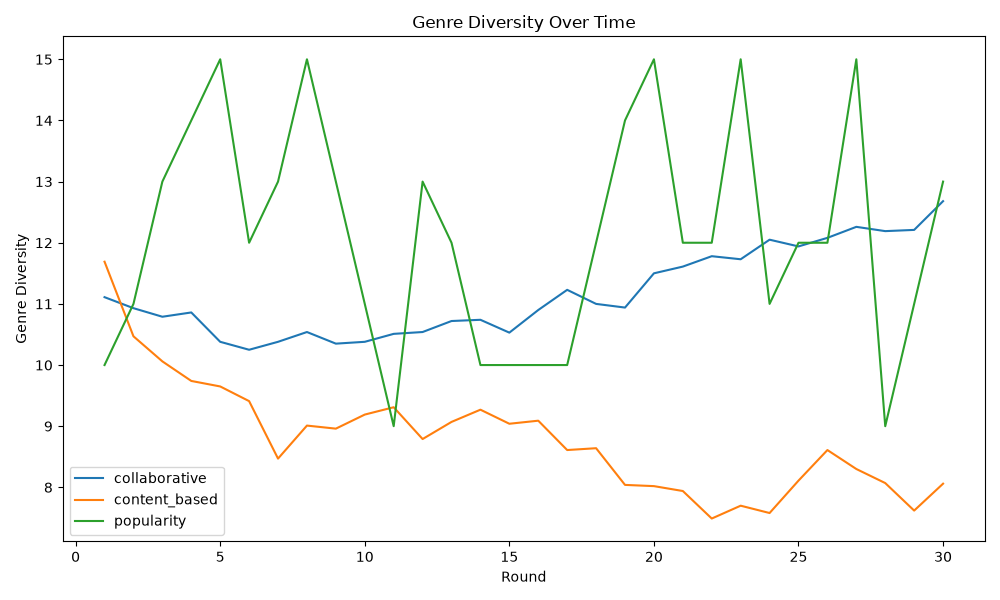
The early results looked clean: collaborative filtering broadened exposure, content-based filtering narrowed it, and
popularity swung widely. Every one of those turned out to be a bug in the simulation rather than a real effect.
Once we had found and corrected the flaws, the three original algorithms showed no difference from random recommendation.
Before: the original baseline The first results looked like three distinct stories: collaborative filtering broadening, content-based narrowing, and popularity swinging wildly. All three trends turned out to be created by bugs in the simulation, not real effects.
Approach
(01) Control
Simulate, against random
A simulation let us isolate mechanisms under controlled conditions. Alongside the three baseline algorithms we added
a random-recommendation control, so changes were compared against noise rather than against zero.
(02) Check
Could the design show an effect?
When the corrected baseline showed nothing, I tested the design itself. Content-based filtering at click rates 100×
apart gave bit-identical recommendations, so it had no feedback loop. Collaborative filtering’s signal came from
neighbouring users, not the individual.
(03) Redesign
Separate taste from the guess
No algorithm both read one user’s preferences and updated from that user’s behaviour. So I split each user’s true
taste (which drives clicks, hidden from the algorithm) from the algorithm’s inferred profile, and built an adaptive
content-based algorithm whose clicks update only the inferred profile.
The redesigned loop
Clicks come from the user’s hidden true taste, but only update the algorithm’s guess. Measuring the gap between the two
shows how far an algorithm’s model of a user drifts from who that user really is.
Evaluation: five defects
Each defect was isolated with a diagnostic and confirmed with a controlled comparison.
01
Shared rating matrix. Users’ simulated clicks leaked into later users’
collaborative-filtering calculations. This created the whole +1.57-genre “broadening”; giving each user their own copy made it vanish.
02
Inconsistent exclusion. Popularity and content-based filtering were
recommending films users had already rated (17.8% and 3.3% of recommendations).
03
Profiles measuring sparsity, not taste. Preference concentration
correlated with rating count at ρ = +0.715. Rebuilding profiles from viewing proportions made the click model about
3.4× better at telling a user’s top genre apart from the rest.
04
Unrealistic click rate. Click rate had been set equal to the affinity
score, giving 49–69% against a realistic 1–5%, so we recalibrated it.
05
Biased tie-breaking. Ties went to the film with the higher ID, which
favours newer films. This affected 91–97% of content-based picks.
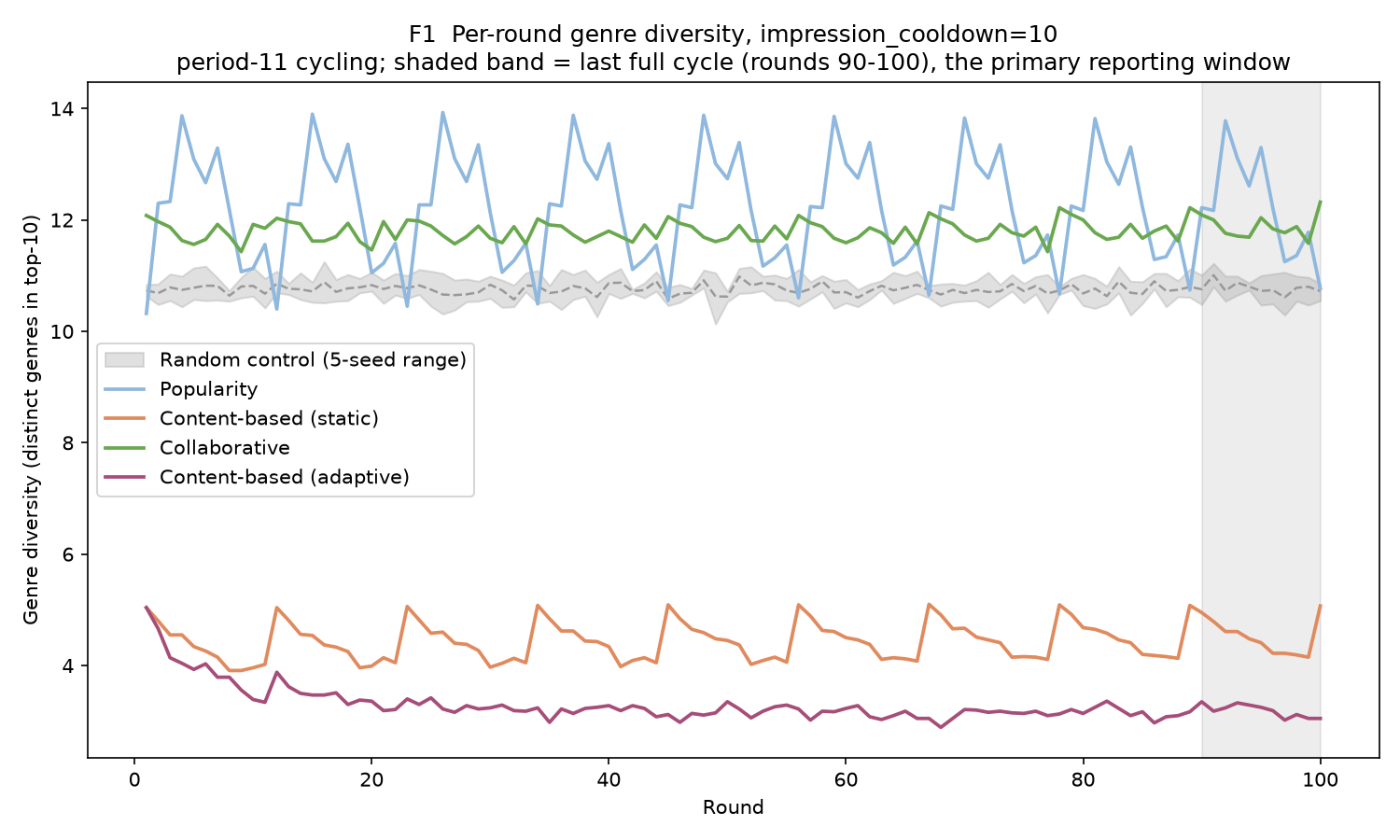
After all that, there was one real effect. The adaptive algorithm narrowed genre variety significantly more than the
fixed one, by about 1.3 genres, and it was the only version that clearly beat the random baseline. Users saw
more different films, but from fewer genres, and the narrowing levelled off after about 30 rounds instead of spiralling.
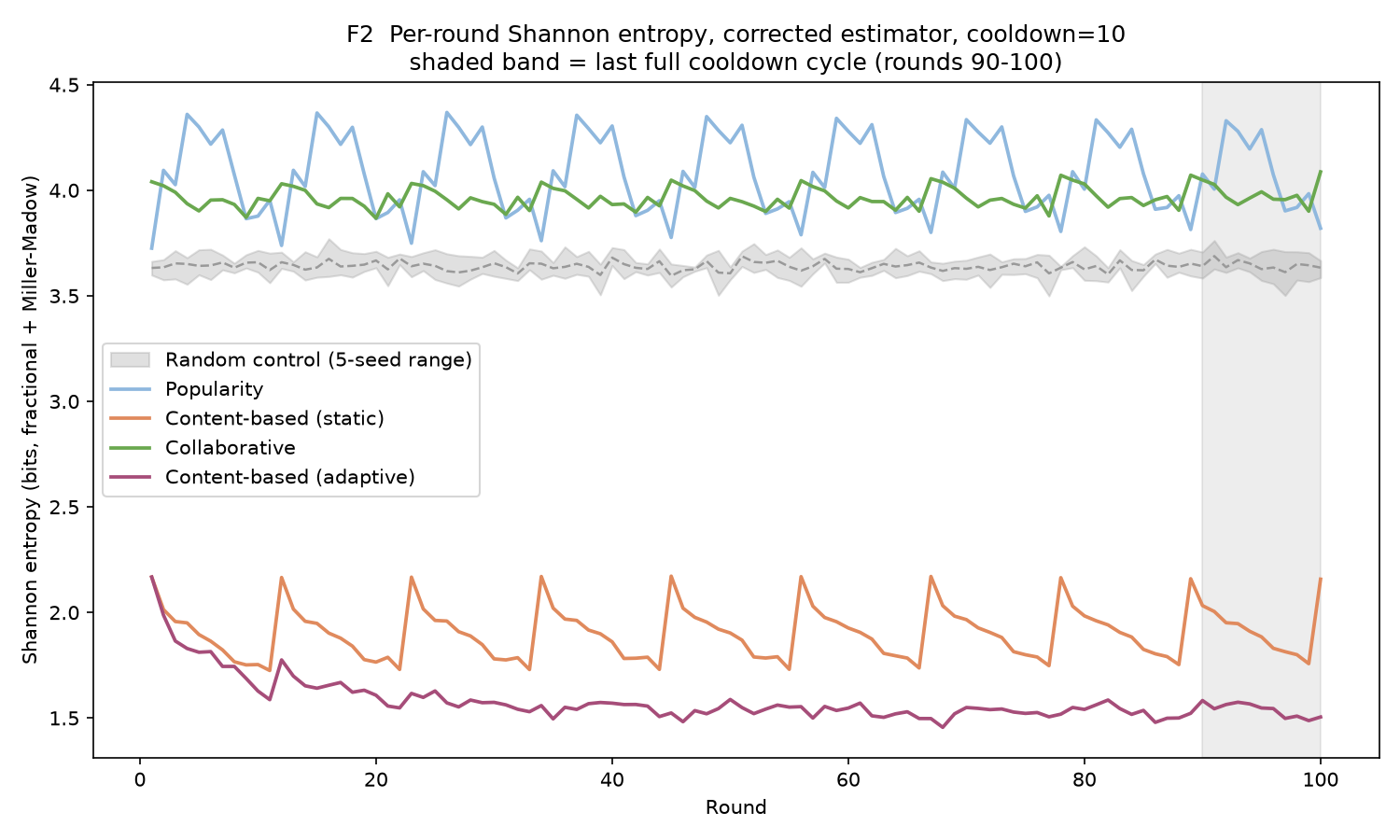
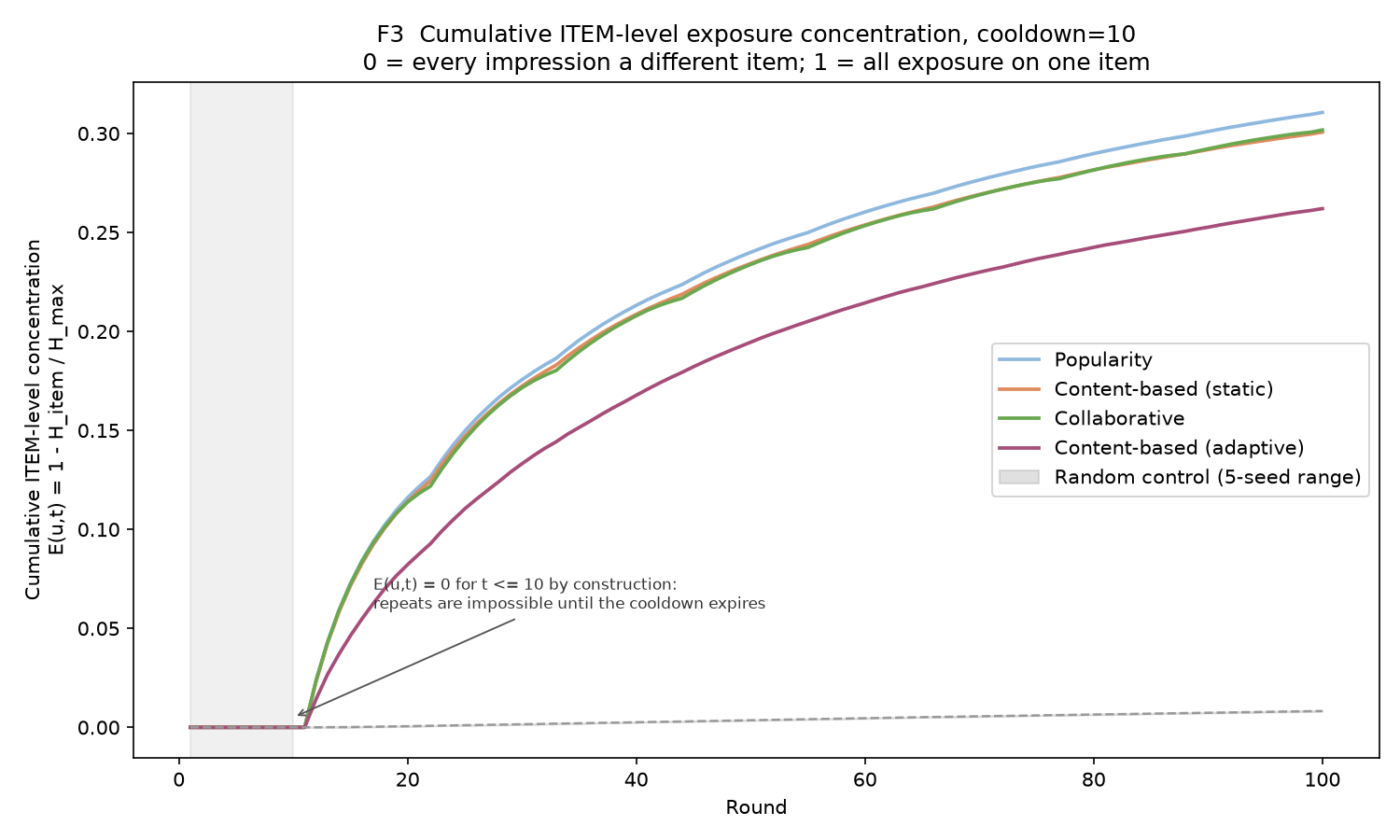
After: corrected genre diversity, 100 rounds Only the adaptive content-based algorithm narrows over time, dropping to about 3 genres per list and levelling off after roughly 30 rounds rather than spiralling. The other three show no narrowing beyond the cycle created by the 10-round cooldown. The shaded band (rounds 90–100) is the last full cycle, which we used as the main comparison window.After: corrected Shannon entropy Entropy tells the same story as genre diversity from a different angle: the adaptive content-based algorithm settles at the lowest genre spread. The repeating sawtooth comes from the 10-round cooldown, so we averaged the last full cycle (rounds 90–100) to compare algorithms fairly.After: how often films repeat This tracks how often the same films are shown to a user again (0 means every impression is a different film). The adaptive algorithm has the lowest repetition of the four, so it narrows genres without showing the same titles more often. Concentration stays at zero for the first 10 rounds by design, because films cannot return until the cooldown ends.
My role
I was the team’s research mentor, so checking that the work was valid was my job. When collaborative filtering kept
trending upward and popularity was jumping around too much to be believable, I did not just accept the explanations
my teammates gave me. I audited the code myself and walked them through each bug as it came to light.
From there I directed the investigation, deciding what to test and which results not to trust, and I caught mistakes
in my own analysis too. I made the main design calls: separating true taste from the algorithm’s guess, building the
adaptive algorithm and adding the random baseline. I also helped my teammates explain their parts of the project, and
wrote up the evaluation for our CREST Silver report.